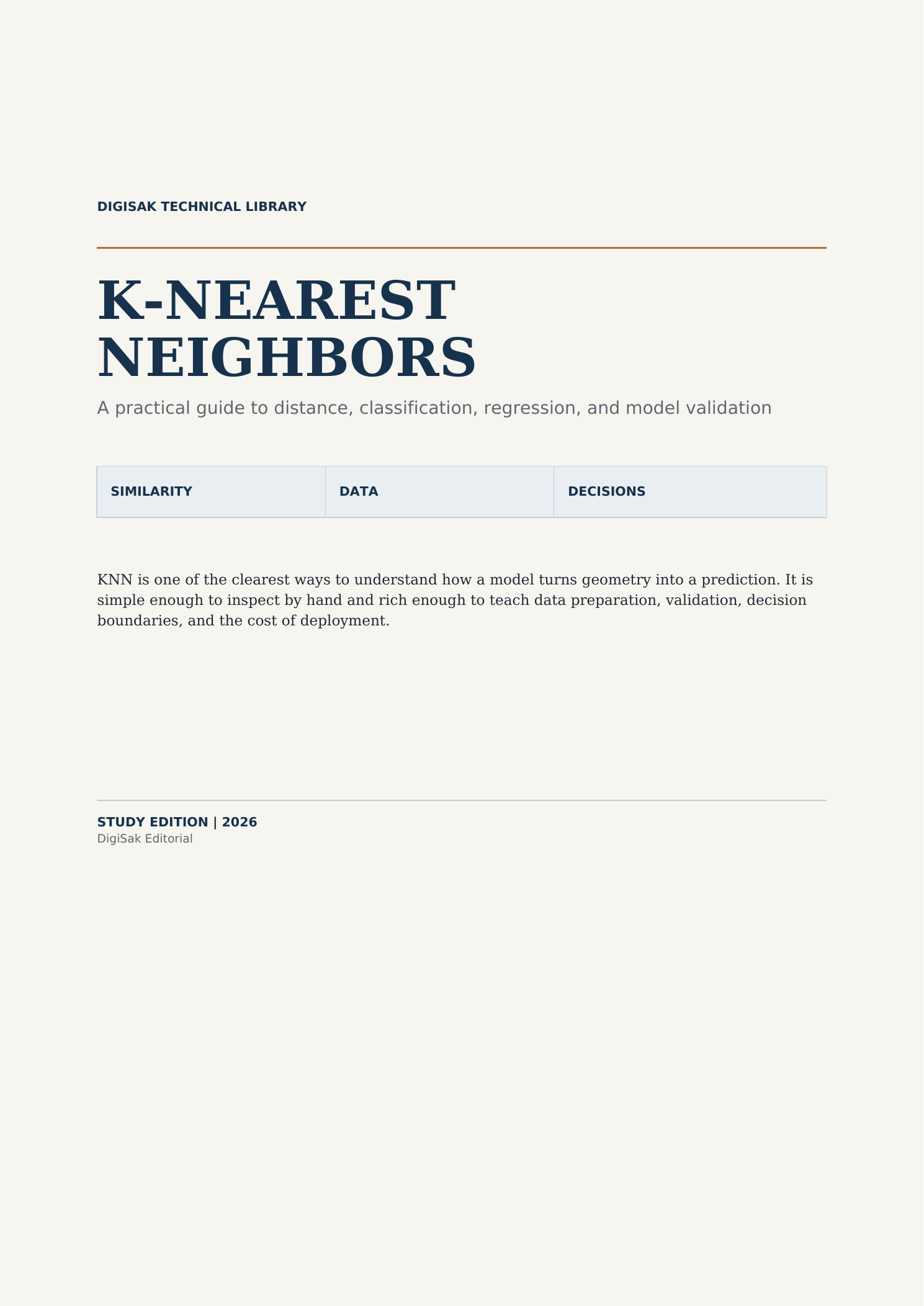
KNN for Machine Learning and Data Science: A Practical Guide is a focused digital reference for learning the k-nearest neighbors model and using it responsibly in real projects.
K-Nearest Neighbors is one of the most intuitive machine learning algorithms: a new observation is compared with known examples, the closest cases are selected, and their labels or numerical outcomes guide the prediction. That simplicity makes KNN an excellent way to understand distance metrics, feature engineering, scaling, validation, local decision boundaries, and model interpretability. It also makes KNN a useful baseline before reaching for more complex models.
What this practical KNN ebook covers
- The KNN mental model: lazy learning, local neighborhoods, the role of k, weighted voting, and weighted averages.
- Distance geometry: Euclidean, Manhattan, Minkowski, and cosine distance, with practical guidance for choosing a metric.
- Data preparation: feature units, scaling, imputation, categorical encoding, duplicates, group-aware splitting, and leakage prevention.
- KNN classification: binary and multiclass voting, imbalance, confusion matrices, precision, recall, F1, and local explanations.
- KNN regression: local interpolation, MAE, MSE, RMSE, R-squared, tuning, and honest baselines.
- Scalable neighbor search: brute-force comparison, KD trees, ball trees, approximate search, memory, and latency.
- Validation and failure analysis: high-dimensional spaces, irrelevant features, coverage, drift, subgroup behavior, and abstention.
- Deployment: reproducible pipelines, downloadable artifacts, inference checks, monitoring signals, and rollback planning.
Who should read it?
This ebook is designed for students studying machine learning, data analysts building their first predictive models, Python developers who want a clear scikit-learn workflow, and AI practitioners who need a transparent baseline. It is also useful for project reports and technical interviews because it explains not only how to fit a KNN model, but how to justify the geometry and evaluate the evidence behind each prediction.
Included practical material
The 34-page PDF contains six focused chapters, Python examples, comparison tables, formulas, checklists, exercises, and a complete mini-project brief. The writing moves from intuition to implementation: first define what similarity means, then prepare a pipeline, fit a baseline, inspect neighbors, measure error, and decide where the model should abstain or ask for review.
Format: PDF digital ebook with instant download after purchase. This is a digital product; no physical item is shipped. You may use the included code patterns as a starting point for your own learning and projects, while verifying the data license and deployment requirements of your application.












Reviews
Clear filtersThere are no reviews yet.