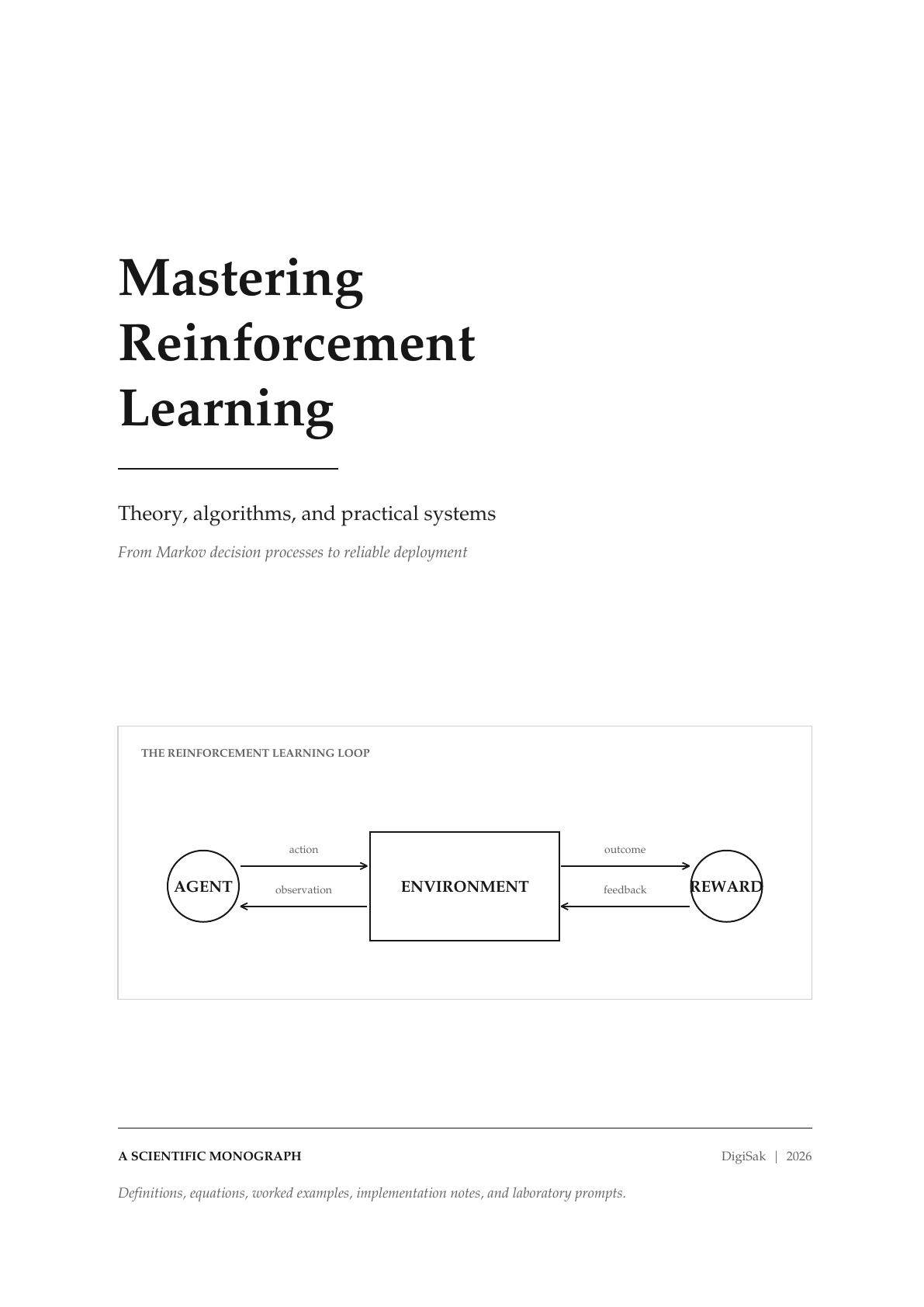
Mastering Reinforcement Learning is a rigorous, practical monograph for understanding how intelligent agents learn to make decisions through interaction. It connects the mathematics of Markov decision processes with the algorithms, experiments, and engineering habits required to build reliable reinforcement-learning systems.
Rather than presenting isolated algorithm names, this ebook builds a complete mental model: an agent observes a state, selects an action, receives feedback, updates its beliefs, and balances exploration with exploitation. That loop is then connected to reproducible implementation, evaluation, safety, and deployment decisions.
Why reinforcement learning matters
Reinforcement learning is useful when decisions unfold over time and an action can change the next situation. Robotics, recommendation, resource allocation, games, simulation, operations research, and adaptive control all require more than a one-shot prediction. The learner must consider delayed consequences, uncertainty, constraints, and the value of information.
The book explains these ideas without hiding the mathematics. Equations are introduced to clarify the assumptions behind an algorithm, then connected to intuition, pseudocode, experiments, and failure modes. This makes the material useful for study as well as for serious project work.
What you will learn
- How states, observations, actions, rewards, policies, and value functions form one learning loop.
- How dynamic programming, Monte Carlo methods, and temporal-difference learning estimate long-term value.
- How Q-learning, SARSA, replay buffers, target networks, and deep value methods work in practice.
- How policy gradients, actor-critic methods, PPO, and continuous-control algorithms are designed and evaluated.
- How model-based, multi-agent, offline, safe, and human-in-the-loop reinforcement learning extend the core framework.
- How to design reproducible experiments, diagnose failures, compare baselines, and prepare systems for deployment.
The agent-environment loop
The first chapters establish the vocabulary that makes every later method easier to understand. You will work with observations, actions, rewards, transitions, policies, returns, and value functions. The distinction between a state and an observation becomes important when the agent cannot see the full environment, while the distinction between immediate and discounted reward explains why an apparently attractive action may be a poor long-term choice.
Markov decision processes and Bellman reasoning
Markov decision processes provide a formal language for sequential decision-making. The ebook develops policies, expected returns, state values, action values, Bellman expectation equations, and Bellman optimality equations. These relationships show how a large planning problem can be decomposed into smaller recursive estimates and why bootstrapping is both powerful and potentially unstable.
Inside the 10 chapters
- The agent-environment loop: observations, actions, rewards, transitions, and the learning problem.
- Markov decision processes: policies, returns, value functions, Bellman equations, and planning.
- Dynamic programming and Monte Carlo: prediction, control, sampling, and the exploration problem.
- Temporal-difference learning: bootstrapping, SARSA, Q-learning, eligibility traces, and stability.
- Function approximation: features, neural networks, replay, target networks, and deep Q-learning.
- Policy optimization: policy gradients, actor-critic architectures, PPO, and continuous actions.
- Model-based and hierarchical RL: learned models, planning, options, and task structure.
- Multi-agent and offline RL: coordination, non-stationarity, datasets, and conservative learning.
- Safe and responsible RL: constraints, uncertainty, evaluation, human oversight, and failure containment.
- Reproducible systems: experiment ledgers, debugging, benchmarks, deployment checklists, and research judgment.
From tabular methods to deep reinforcement learning
Tabular methods make the learning signal visible. Dynamic programming shows what is possible when the environment model is known; Monte Carlo methods learn from complete episodes; temporal-difference methods update from partial experience. The guide then explains why function approximation is needed for large or continuous spaces and how neural networks, replay buffers, target networks, and exploration strategies change the engineering problem.
Worked comparisons help readers reason about bias, variance, on-policy and off-policy learning, sample efficiency, stability, and computational cost. The emphasis is on choosing a method for a problem, not using a fashionable algorithm without a baseline.
Policy gradients, PPO, and continuous control
Value-based methods are not always the best fit for continuous actions or stochastic policies. The ebook introduces policy gradients and actor-critic architectures, then explains how advantage estimates, clipping, entropy regularisation, and trust-region ideas support practical policy optimisation. PPO is presented with the assumptions and diagnostics that make it useful, along with common implementation mistakes that can produce unstable learning.
Model-based, multi-agent, and offline settings
Modern reinforcement learning often operates beyond a single agent in a clean simulator. The book discusses learned environment models, planning, hierarchical decomposition, coordination, non-stationarity, and the difficulties of learning from logged data without additional interaction. These chapters help readers understand where distribution shift, partial observability, reward misspecification, and credit assignment create risk.
Evaluation and reproducible experiments
A learning curve alone is not enough evidence. You will learn how to define baselines, separate training and evaluation environments, report seeds and confidence intervals, track hyperparameters, inspect failure cases, and compare policies with consistent metrics. Experiment ledgers and small ablation studies make conclusions easier to reproduce and prevent a single lucky run from being mistaken for a robust result.
Safety and responsible deployment
Reward functions are proxies, and an agent can optimise a proxy in ways the designer did not intend. The guide therefore treats constraints, uncertainty, human oversight, rollback plans, monitoring, and failure containment as core parts of reinforcement-learning engineering. High-impact systems require conservative evaluation and a clear boundary between simulation results and real-world claims.
Designed as a serious study reference
The book combines equations, worked examples, implementation guidance, laboratory prompts, review questions, and practical checklists. It is written for AI and data-science students, engineers, researchers, and technical practitioners who want more than a collection of algorithm names. It can be read from beginning to end or used as a reference while building a controlled experiment.
Digital product details
- Format: PDF ebook
- Length: 517 pages, including 500 instructional pages
- Scope: foundations, deep RL, model-based RL, multi-agent RL, offline RL, and safe deployment
- Includes: equations, algorithms, examples, diagnostics, experiment checklists, and review prompts
- Delivery: instant digital download after purchase
- No physical product will be shipped
Build the judgment to choose, implement, evaluate, and responsibly deploy reinforcement-learning methods.









Reviews
Clear filtersThere are no reviews yet.