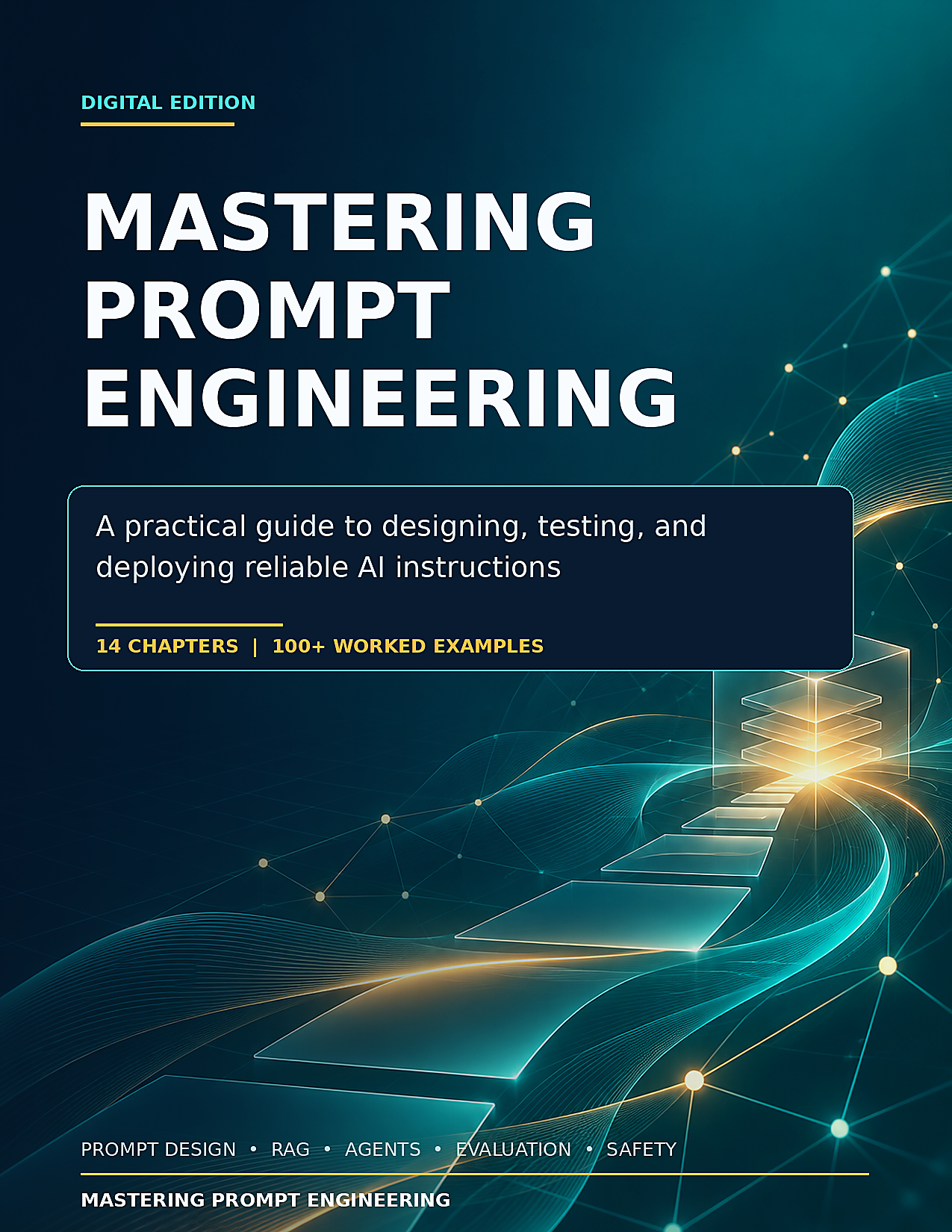
Mastering Prompt Engineering is a practical, professional guide to designing, testing, and deploying reliable instructions for modern AI systems. It helps readers move beyond trial-and-error prompting and build repeatable workflows that produce clearer, safer, and more useful results.
Whether you are a student, creator, developer, researcher, entrepreneur, or team leader, this 14-chapter ebook shows you how to turn a vague request into a well-defined task, give an AI system the right context, evaluate its output, and improve the process over time.
What prompt engineering means in practice
Prompt engineering is not about finding one magical sentence. It is a structured method for communicating a goal, the relevant information, the limits of the task, and the form of the expected result. A strong prompt makes assumptions visible, reduces ambiguity, and gives the model a reliable way to check its own work.
This ebook presents prompt engineering as a workflow: define the job, identify the audience, provide grounded context, set constraints, request a useful format, test representative cases, and revise based on evidence. The method works across writing, research, coding, data analysis, planning, customer support, and AI-assisted operations.
Who this ebook is for
- Students who want clearer explanations, study plans, revision questions, and feedback.
- Creators and writers who need ideation, outlining, editing, and tone control without losing their own voice.
- Developers and data professionals who want help with code review, debugging, documentation, SQL, and analysis.
- Researchers and analysts who need source-aware summaries, comparison frameworks, and reproducible notes.
- Entrepreneurs and team leaders who want reusable AI workflows instead of isolated experiments.
The core prompt framework
Each workflow begins with a simple specification. State the role or point of view that is useful, describe the task in concrete terms, provide the context and source material, define constraints, specify the audience, and describe the output format. Finally, add a quality bar: what should be accurate, complete, cautious, or explicitly marked as uncertain?
- Goal: explain the result you need and why it matters.
- Context: supply the facts, documents, examples, or data the system should use.
- Constraints: set length, tone, scope, exclusions, privacy rules, and deadline.
- Output: request a structure such as a table, checklist, JSON object, lesson, or draft.
- Evaluation: define how you will review accuracy, relevance, completeness, and risk.
From one prompt to a reliable workflow
A single prompt can be useful, but a reliable system separates planning, execution, checking, and revision. The ebook demonstrates how to create a small sequence of prompts: one to clarify the task, one to generate a first result, one to challenge assumptions, and one to format the final answer. This approach makes errors easier to spot and makes successful work easier to repeat.
You will also learn when to use examples. A carefully selected example communicates the desired pattern more clearly than a long instruction. The guide explains how to choose representative examples, avoid accidental bias, and test whether the workflow still works when the input changes.
Prompt engineering for research and writing
For research, the guide emphasises source boundaries and uncertainty. Ask the system to distinguish supplied evidence from interpretation, identify missing information, keep quotations short, and flag claims that require verification. For writing, separate idea generation from editing: first develop the argument, then check structure, then refine clarity and tone. This preserves human judgment while using AI where it adds speed.
Reusable templates help you create consistent briefs, article outlines, literature notes, interview preparation, and content calendars. The goal is not to automate every decision; it is to make good decisions easier to repeat.
Prompt engineering for coding and data work
Technical prompts become stronger when they include the environment, inputs, expected behaviour, constraints, and a minimal example. The ebook shows how to request a plan before code, ask for assumptions and edge cases, compare alternatives, and require tests or validation steps. For data tasks, specify the schema, missing-value policy, evaluation metric, and acceptable uncertainty instead of asking for a generic analysis.
These practices reduce rework and make AI-assisted development more reviewable. They also support better collaboration because another person can understand what the system was asked to do and why a particular output was accepted.
Evaluation, safety, and human review
Good prompt engineering includes quality control. The guide introduces simple rubrics, test cases, regression checks, and error logs that help you compare versions of a workflow. You will learn to test normal inputs, ambiguous requests, incomplete data, adversarial wording, and cases where the correct response is to ask a clarifying question or refuse.
Privacy and safety matter as much as convenience. Do not place confidential data into tools without authorisation, remove unnecessary personal information, check generated claims against trusted sources, and keep a human responsible for high-impact decisions. The ebook treats responsible use as part of professional prompt design, not as an optional final paragraph.
What is inside the ebook
You will find 14 focused chapters, 100+ worked prompt examples, practical exercises, reusable templates, evaluation scorecards, troubleshooting guidance, a glossary, and a 30-day practice plan. Each chapter connects a concept to a real use case so you can apply it immediately and adapt it to your own tools.
Digital product details
- Format: PDF ebook
- Length: 100+ pages
- Includes: 14 chapters, worked examples, templates, exercises, checklists, and a 30-day plan
- Best for: students, creators, technical teams, researchers, and business users
- Delivery: instant digital download after purchase
- No physical product will be shipped
Continue learning
For a technical reference, consult the official prompt engineering guidance and explore the DigiSak AI agents guide for a complementary workflow perspective.
Build clearer prompts. Get more dependable outputs. Create AI workflows you can reuse.












Reviews
Clear filtersThere are no reviews yet.